The Erie Times-News has granted anonymity to the person identified as James because of the sensitive nature of addiction and recovery. Times‑News editors are aware of the individual’s identity and his account has been verified.
Looking back at the start of his gambling addiction, James pointed toward a single moment that sent him down a path that cost him his job, wife and family.
It was when he won $14,000.
The 34-year-old Erie man started gambling online about six years ago by playing in a few fantasy football leagues. He moved to online daily fantasy football sites and online sports betting.
2026: Up to 6.4% of Pa. adults could be problem gamblers, study finds
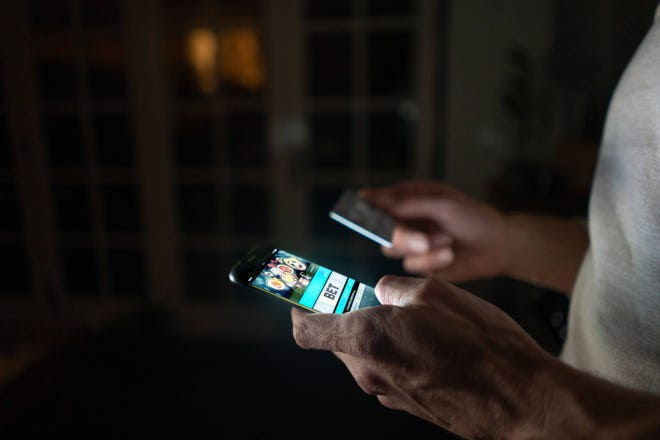
"Then I started playing online slots," James said. "With sports betting, you have to wait for the results. But the slots are almost instant."
One night in 2021, he hit an online slots jackpot for about $14,000. He traveled to the Pittsburgh-area casino that owns the gambling app he used and collected his winnings in person because "I wanted to hold that much money in my hand."
What should have been a celebration turned into the moment James' addiction took full control. He quickly gambled away $5,000 of the winnings and told his longtime girlfriend the rest would be used to pay for car repairs and other bills.
Instead, he gambled away that money over the next month.
"I just kept going to CVS (Pharmacy) and buying prepaid debit cards to put on different gambling apps on my phone," James said. "When the money was gone, it was hard to tell my girlfriend. The car was in the shop and she asked me to pay the bill so we could get the car. I had to tell her that I couldn't pay it."
Pennsylvania legalized online gambling in 2017
Online gambling became legal in Pennsylvania in 2017 when Act 42 was passed, permitting online lottery and casino games. Online sports gambling followed in 2019.
The COVID-19 pandemic struck a year later, which gave people a lot of free time at home, said Josh Ercole, executive director of the Council on Compulsive Gambling of Pennsylvania.
"It created a perfect storm," Ercole said. "People were home because of COVID with not much to do. It propelled online gambling in a very expedited way."
Ercole's council began seeing a significant increase in calls from problem gamblers, from around 1,100 a year before the pandemic to more than 2,000 in 2021. A growing number of these calls were from young men like James.
More: How Pa. gambling helpline calls, number of self-imposed bans have changed in recent years
"The biggest growth we saw was in calls from people ages 18 to 24, though we would even get calls from teenagers," Ercole said. "Since many of them weren't legal to gamble, it means they were gambling on unregulated sites."
Besides seeing more young people addicted to gambling, Ercole and the council noticed they were developing their addictions more rapidly.
"If the seed is planted, we saw that the addiction could start in a short amount of time," Ercole said. "Within a month or two, the person would go from having a healthy relationship with gambling to an addiction."
James realized he was addicted around the time he gambled away the $14,000. He tried to curb it by excluding himself for a year from brick-and-mortar casinos in the region and various online casinos.
It helped for a month or two, but the addiction never goes away, James said. He found unlicensed, unregistered online casinos that didn't require identification, just a prepaid debit card.
One online bet every 2 seconds for 3 hours
In October 2025, James' addiction might have hit its lowest point. He spent 17½ of a possible 24 hours sitting on his couch, drinking beer, smoking cigarettes and playing online slots through an unlicensed casino.
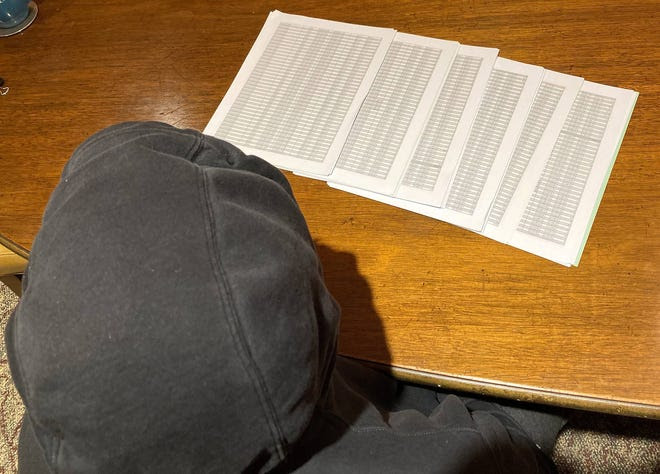
"I have every bet I made listed in this log," James said, holding a clipped stack of paper a half-inch thick. "I made 11,331 bets, averaging $10.06 a bet. During one three-hour period, I was making a bet every two seconds on slots."
He lost only $70 during his binge, and that was only because the casino voided his winnings when he didn't follow its wagering rules. Since the site was unregulated, there was nothing James could do.
But by this point James had lost much, much more. His girlfriend and their two children had moved out. He also had lost his job and spent $5,000 of his 401(k)-retirement savings plan.
"I used to have hobbies. I went thrifting, bought and sold things to make extra money," James said. "I don't do anything else now. I'm stuck and lost."
Why online gambling is difficult to spot, treat
James sees a gambling addiction specialist at Catholic Charities Counseling and Adoption Services in Erie.
Gambling addiction has changed with the rise in online gambling, said Cielo Prischak, a clinical supervisor at Catholic Charities.
"When gambling lives on a phone in your back pocket, it's even harder to stop," Prischak said. "You don't have to go to a casino or even a convenience store to buy lottery tickets."
Since it appears to others, even family members, that you're just scrolling on your phone, spotting an online gambling addiction can be difficult. James would gamble while sitting near his girlfriend in the living room.
Minors making bets, too: From Fortnite to sports bets, Pa. kids might be gambling unknowingly
Symptoms, treatments for gambling addiction
There are the traditional "tells" that someone is addicted to gambling: increased irritability, financial shortfalls that aren't easily explained, more lying about where they spend their time or money.
"With online gambling, you are doing it alone so you are isolating yourself," Prischak said. "Family members have less chance to spot you gambling."
Treatment for gambling addiction is often cognitive behavioral therapy, in addition to support group meetings and financial counseling.
Cognitive behavioral therapy is a type of talk therapy that helps the person with an addiction change the thinking patterns that can lead to gambling.
"It works well for gambling addiction, especially understanding the link between their thoughts and behaviors," Prischak said. "Like when a gambler is chasing that next win, or that they believe they are due to win."
'We're betting on everything': Little League World Series fans irked by offshore gambling
Gambler asks, 'Why stop now?'
Working with a counselor at Catholic Charities has helped James, but he continues to gamble.
The problem, like with other addictions, is that James can avoid gambling for days and even weeks, but all it takes is one bad night.
"I can put together a few good days, but the nights can be difficult, especially when I'm alone or I'm with the kids and they are sleeping," James said. "It's like, 'Why stop now?'"
If you struggle with gambling addiction, help is available by calling 1-800-GAMBLER or Catholic Charities Counseling and Adoption Services at 1-814-456-2091.
Contact David Bruce at dbruce@timesnews.com or by calling 814-870-1736.